When Building Enquiries Pile Up Faster Than You Can Quote Them
Having too many enquiries sounds like a good problem to have.
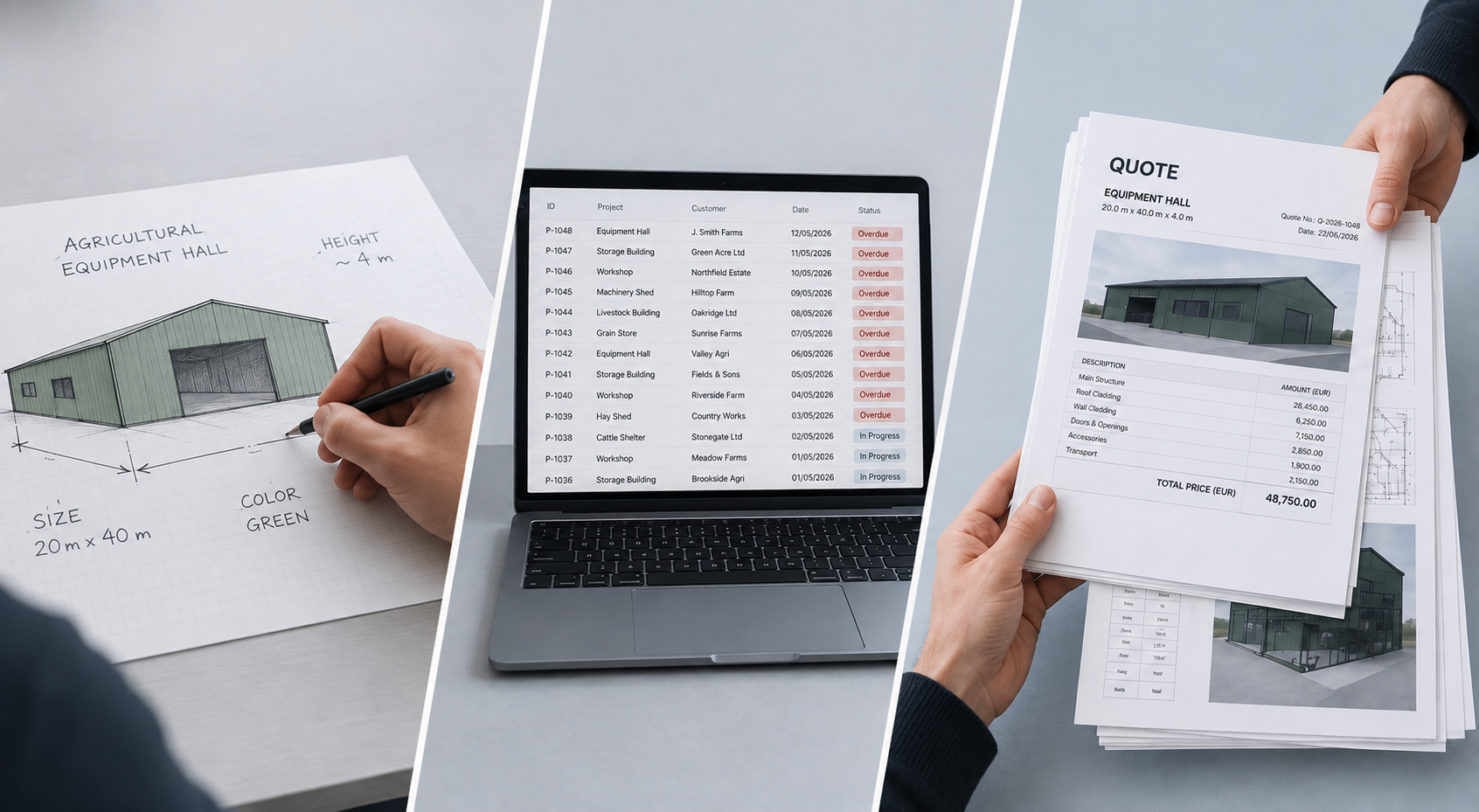
Until there are more than 150 of them waiting to be processed.
This was the situation described to us by the owner of a company producing prefabricated timber buildings. Their projects range from agricultural buildings and equestrian halls to workshops, warehouses and commercial buildings.
The customers were there. So was the demand.
The problem was turning all those enquiries into actual proposals.
Before a customer could make a decision, someone had to understand what they wanted and prepare an initial building concept. Then came drawings, material quantities and a quotation. Some parts of the project also needed input from specialists.
The company had people doing all of this. They simply did not have enough hours to do it for everyone who was asking.
Hiring more people would increase capacity, but only in small steps.
The bottleneck between an enquiry and a quotation
This is quite different from the problem of generating more leads.
Some manufacturers need more enquiries. Others already have enough and face a different question:
How can we process more building enquiries?
For a manufacturer of prefabricated buildings, preparing a quotation can involve a surprising amount of work.
A customer may start with a fairly simple request:
"We need a new workshop with an office."
But before there is anything meaningful to quote, dimensions need to be established. A structural concept has to be selected. Doors, windows, cladding and other options need to be defined. Material quantities have to be estimated. Drawings or visualisations may be required. Some projects need specialist engineering input.
Eventually, all this has to become a price.
And there is still no order.
Perhaps the customer will buy. Perhaps they will choose another supplier. Or perhaps they will return two days later asking for the building to be five metres longer, with another door and a different roof.
Then part of the process starts again.
Being first matters
Quotation capacity is also about speed.
When a customer asks several manufacturers for a proposal, the company responding first has an obvious advantage. The customer can see something concrete, discuss it internally and start making decisions while competing proposals are still being prepared.
Yet speeding up a conventional process is difficult.
A salesperson can work faster. A CAD designer can reuse previous drawings. An estimator can improve their spreadsheets. A specialist can prioritise urgent jobs.
But the project is still being handed from one person to another.
Sales → design → specialist → estimating → sales.
If every new enquiry follows that route, capacity remains closely tied to the number of people available.
This was why the manufacturer with more than 150 enquiries was looking for a different approach.
They did not need every specialist to work a little faster. They needed one person to be able to prepare much more of the proposal independently.
Does every custom building need a custom quotation process?
A conversation with another building manufacturer from Germany brought a different perspective to the same problem.
This company also produces structures that initially appear to be highly bespoke.
Customers arrive with different dimensions, uses, layouts and requirements. The natural response had always been to treat each project individually.
But after completing enough projects, the company started seeing patterns.
The buildings were different.
The decisions behind them often were not.
Certain spans led to certain solutions. Particular building types used similar systems. Components and details appeared repeatedly. Previous experience could be reused. Some supposedly bespoke solutions could even be replaced with standard systems without changing what the customer wanted from the finished building.
That leads to an important distinction:
A custom building does not necessarily require a custom quotation process.
A customer can still receive a building tailored to their needs while the manufacturer uses a systematic process to design, calculate and quote it.
This is where a capacity problem starts to become a systematisation problem.
Standardise the rules, not necessarily the building
Systematisation does not have to mean offering three standard buildings in three standard sizes.
For many manufacturers, that would remove exactly what makes their product attractive.
Instead, the repeatable part can be the logic behind the design.
A configurable system can define which dimensions are possible, which systems can be used and which options can be combined. It can also contain rules for the components and quantities required when the design changes.
The salesperson or estimator still creates an individual project, but works inside a system containing the manufacturer's experience.
Change the width and the model updates.
Add an opening and the relevant information changes with it.
Select another building option and predefined rules determine what needs to change instead of someone rebuilding the project manually.
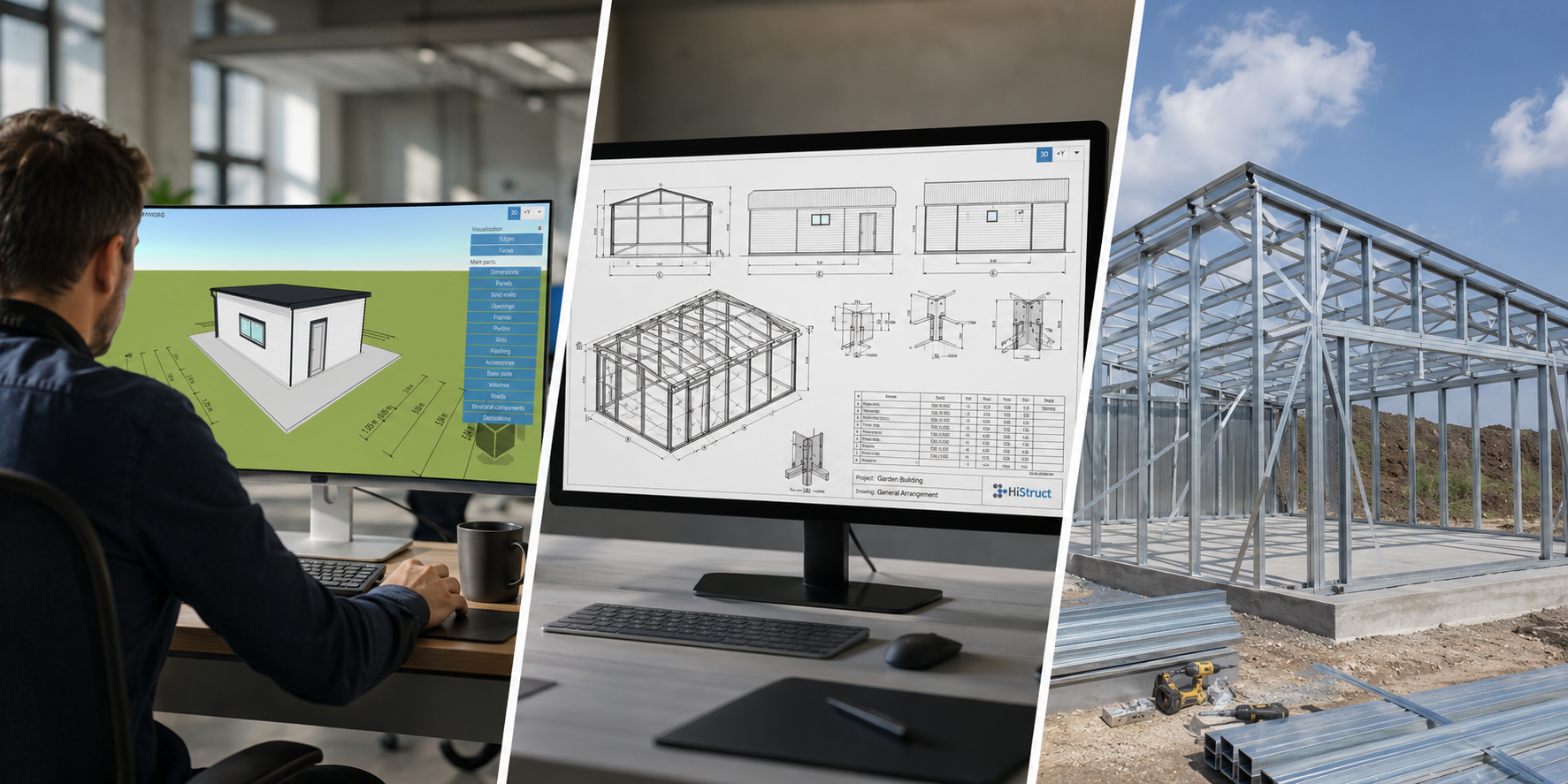
Depending on the implementation, the same project data can then be used for 3D visualisation, drawings, bills of materials and quotations. It can also be exchanged with specialised engineering or production software.
The goal is not to remove expertise from the process.
It is to stop spending expert time on decisions the company has already made hundreds of times before.
What could one person do from start to finish?
This can also change how a manufacturer organises its team.
The second company was considering moving away from departments defined purely by profession.
Instead of one person selling, another drawing, another estimating and another preparing technical information, they were considering teams responsible for particular product groups.
One person could take a project much further from the initial customer requirement towards a complete proposal.
That person would not suddenly become a structural engineer, CAD specialist and estimator at the same time. The software would carry more of the repeatable product knowledge.
If preparing a proposal requires expert knowledge at every step, adding more enquiries means adding more experts.
If much of that knowledge can be expressed as product rules, a capable salesperson or project estimator can handle more of the process independently. Specialists can then focus on the parts where their expertise is genuinely required.
Automation starts with understanding what actually repeats
It is tempting to look at an existing quotation process and simply automate every step.
In our experience with building configurator projects, some of the most valuable work happens before that.
First, the manufacturer needs to identify what is genuinely unique and what only appears unique because it has always been handled manually.
That raises some useful questions.
- Do we really need this many construction variants?
- Could two details be replaced by one system?
- Are we calculating something repeatedly that could follow predefined rules?
- Could a standard roof system satisfy the same customer requirement?
- Which decisions require a specialist, and which are already based on established company practice?
Software becomes much more useful once these questions have answers.
The aim is to create a process in which people spend their time on the parts of a project where human judgement actually adds value.
Why this cannot be completely plug-and-play
There is also a reason why a system like this usually requires close cooperation between the manufacturer and the software provider.
Every manufacturer works differently.
Two companies may both produce timber halls, steel buildings or modular structures and still use different structural systems, dimensions, components and quotation methods. They may work under different regulations or require different drawings, calculations and manufacturing data.
A software platform can already provide the underlying tools: 3D configuration, product rules, drawings, bills of materials, quotations, project revisions and connections to other systems.
But it cannot know how your company builds.
That knowledge has to come from the manufacturer.
Implementing such a system therefore means translating the manufacturer's experience into rules that software can use. It requires cooperation between people who understand the product and people who know how to turn that knowledge into a configurable workflow.
This takes effort.
But the alternative is to keep increasing quotation capacity mainly by adding more people to the same process.
More enquiries do not always require more people
Having too many enquiries seems to have an obvious solution: increase the size of the team.
Hire another estimator. Then perhaps another CAD designer or salesperson.
Capacity increases, but the basic relationship remains the same: more projects require more people.
Another option is to examine what happens between receiving an enquiry and sending a quotation.
How many steps are genuinely unique?
How many follow rules your team already knows?
How many times is the same information recreated in CAD, Excel and other tools?
And how much more could one person handle if the company's product knowledge were available directly inside the software?
For manufacturers dealing with a growing backlog of building enquiries, these may be more useful questions than simply asking whom to hire next.
The final building can remain individual.
The process used to get from an enquiry to a proposal does not have to be.
In short
- Too many enquiries can create a quotation capacity problem, even when production capacity is available.
- Custom buildings often contain more repeatable rules and systems than they first appear to.
- A custom building does not require every quotation to be created from scratch.
- Product knowledge can be built into a configurable workflow, allowing salespeople and estimators to handle more of a project independently.
- Specialists remain essential where genuine engineering judgement is required.
- 3D models, drawings, material quantities and quotations can use the same project data instead of being recreated separately.
- Building such a system requires the manufacturer's own rules and experience. It is therefore a collaboration rather than a plug-and-play software purchase.
- The result is a way to process more enquiries without increasing headcount at the same rate.