You've Built the Production Line. Now Build the Business Around It.
Investing in a roll-forming line for cold-formed steel profiles is no longer unusual. Across Europe, more and more companies are manufacturing lightweight building systems for garden rooms, garages, carports, workshops and small industrial buildings. The products are easy to transport, quick to assemble and offer enormous commercial potential.
But this is where many business plans stop.
Building the product is only the first step.
Building a scalable business around it is something entirely different.
Over the past few years, we've noticed the question coming up again and again when speaking with manufacturers of cold-formed steel building systems.
How do we turn our production capacity into a business that can grow without constantly adding more people?
The question isn't only about selling directly to end customers.
Most manufacturers want builders, installers, dealers and distributors to be able to sell their system as well. The more people who can confidently design and quote projects, the more valuable the production capacity becomes.
One manufacturer summed it up surprisingly well:
"I don't want to become the biggest profile manufacturer. I want people I've never met to be building with our system."
That is the point where the discussion changes.
It stops being about manufacturing.
It becomes about scalability.
A production line makes profiles. A business model makes projects.
Imagine a typical enquiry:
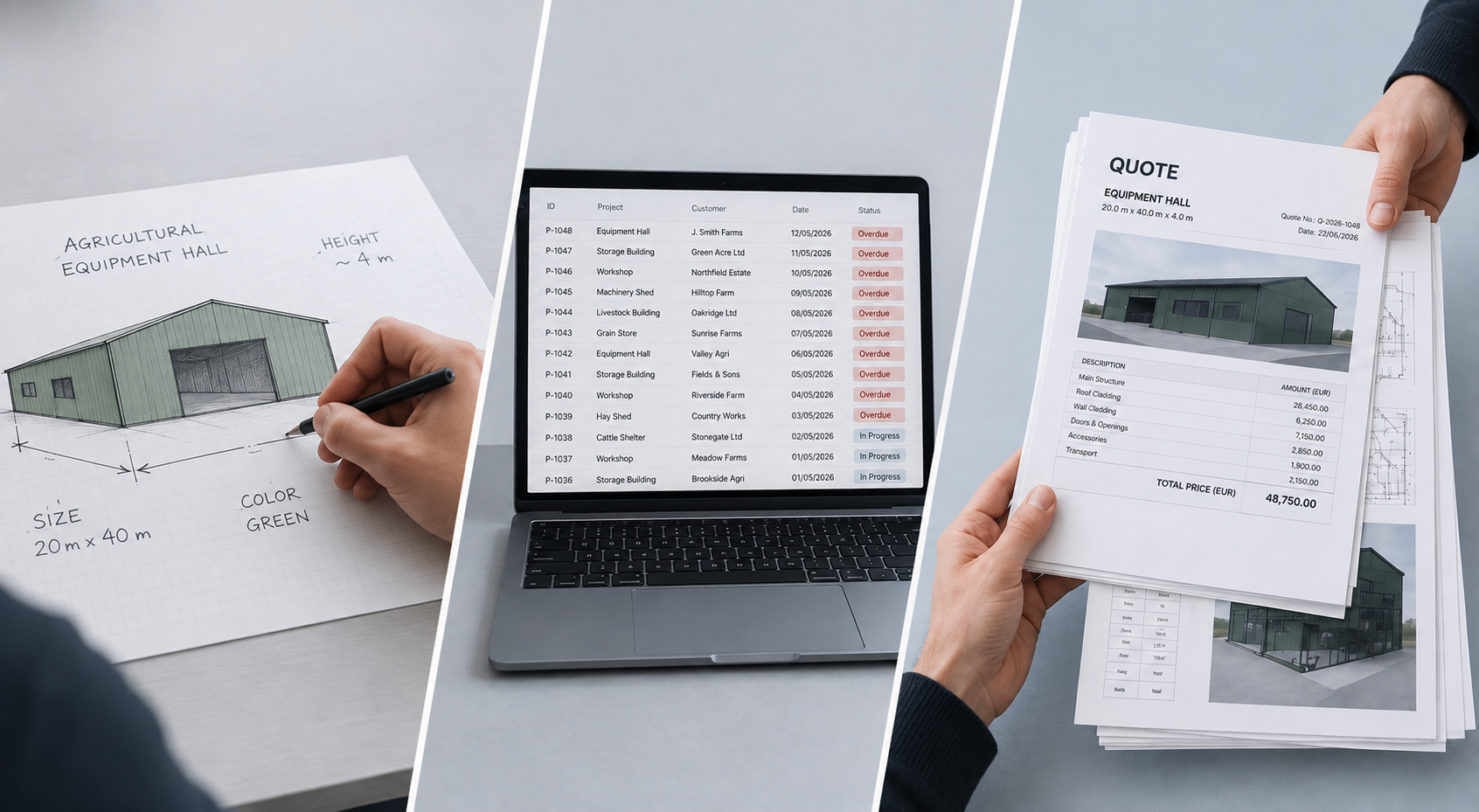
A customer wants a garage or a garden room, or a carport. Someone discusses the requirements, prepares the first concept, calculates the material quantities, produces a quotation, revises the design several times and finally creates the drawings before production can begin.
This works perfectly well when you're handling a handful of enquiries each week.
It becomes a bottleneck when you're aiming for dozens or hundreds. Every additional project requires more engineering time, more estimating and more administration.
Eventually, growth becomes directly linked to headcount.
Your greatest asset isn't the steel.
At first glance, these systems often appear straightforward. A limited number of profiles. A handful of connection details. Several standard roof types.
Simple.
Until you begin documenting how the product actually works.
That's when the real intellectual property starts to emerge. It isn't hidden inside the profiles themselves. It's hidden inside the rules.
For example:
- Which profile should be used in each part of the structure?
- How far apart can the framing members be?
- Where is bracing required?
- How should corners, ridge details and foundations be connected?
- Which fixing methods should be used?
- Where does the standard system end, and where is a different structural solution required?
These rules have usually evolved over many years.
In many companies, they exist only in the minds of a few experienced people. Yet they determine whether a system can genuinely be sold at scale.
A beautiful 3D model isn't enough.
There are plenty of tools capable of producing attractive visualisations.
There are CPQ platforms.
Parametric modelling environments.
General-purpose configuration software.
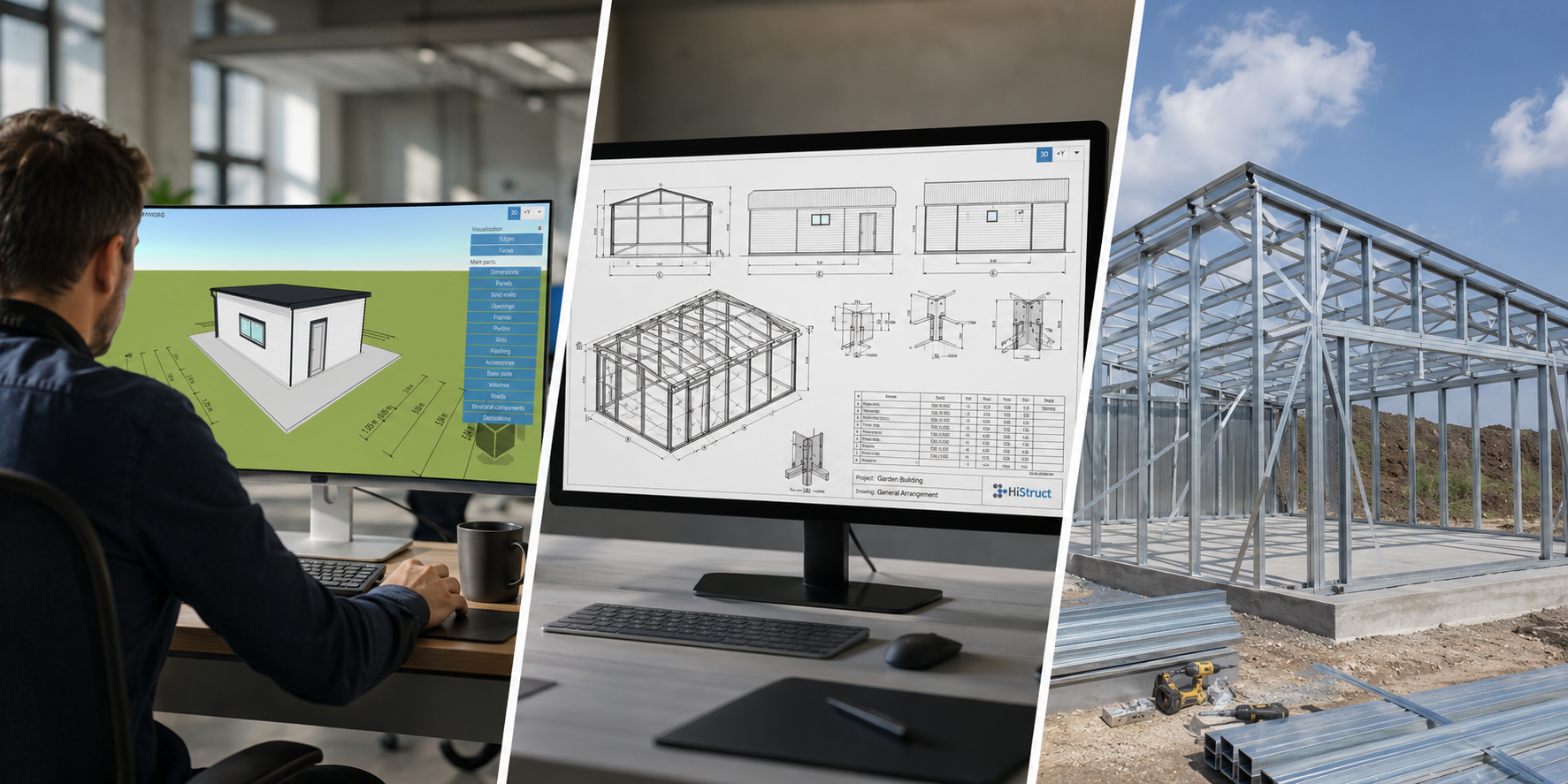
For building systems, however, visualisation is only the beginning. A practical solution must also understand the manufacturer's construction logic. It should generate accurate bills of materials, prepare quotations, produce technical drawings and provide structured data for downstream business and manufacturing systems.
Once you look at it from that perspective, the configurator stops being a marketing feature. It becomes part of the company's operating model.
What manufacturers are really looking for.
Interestingly, most companies aren't actually searching for software.
They're searching for a way to multiply their expertise.
They want homeowners to configure projects themselves.
They want dealers to prepare quotations without becoming structural specialists.
They want sales teams to respond immediately instead of waiting for engineering.
They want manufacturing to receive consistent, reliable project data.
They want the same process to work across multiple regions and, eventually, multiple countries.
That's no longer a software discussion.
It's a business discussion.
How does this transition actually happen?
Companies that successfully scale their building systems rarely start by automating everything at once. Instead, they begin with the part that creates the biggest business impact.
They make it easy for customers, dealers and sales teams to configure a building online, generate qualified enquiries and quickly turn them into quotations. At this stage, many manufacturers still prepare the final engineering documentation using their existing processes, but the time spent getting there is dramatically reduced.
Once that workflow proves its value, the system gradually evolves.
Bills of materials become automated. Technical drawings are generated directly from the configured model. Project data starts flowing into ERP, CRM and manufacturing systems. Eventually, the configurator becomes much more than a sales tool. It becomes the common thread connecting everyone involved in the project—from the customer exploring different design options, through the sales team preparing the quotation, to engineering, manufacturing and, finally, the installation team working on site.
The important part is that this evolution doesn't begin from a blank sheet of paper.
A construction configurator already understands the foundations of building products. The development effort focuses on capturing the manufacturer's own engineering know-how—the framing rules, connection details, structural logic and product-specific constraints that make their system unique.
That's why the first production-ready version can often be delivered within weeks rather than years, while the platform continues to grow alongside the business itself.

Scaling doesn't have to mean hiring.
Every manufacturer eventually faces the same strategic decision.
Should growth come from employing more estimators, engineers and salespeople? Or should it come from building a system that allows the existing team to deliver significantly more projects while enabling partners and distributors to do much of the early design work themselves?
There isn't one universal answer.
But we're seeing an increasing number of manufacturers choosing the second path - not because they want to replace people with software, but because they want their business to grow faster than their office.
Perhaps that's becoming the real competitive advantage for the next generation of building system manufacturers.